
The Great Housing Debate
A JaxBNimble "docudrama"
ROAD to Housing or a Dead End?
LEGAL DISCLOSURE: GENERATIVE AI SYNTHESIS
This content has been created in whole or in part with the use of generative artificial intelligence (AI).
NOTICE: The following text is a simulated intellectual synthesis of the public record, published research, and stated policy positions of Dr. David Jaffee and Matthew Yglesias. It is NOT a transcript of an actual conversation, nor has it been authorized, recorded, or endorsed by either participant.
This "mock debate" is presented by JaxBNimble.net as a decision-support tool to explore a "Middle Ground" for Jacksonville's housing crisis. It uses AI to bridge the "arcana" of market supply and community protection.
Welcome to JaxBNimble's first mock debate. In it an AI-assisted attempt of a Democratic Capitalist to imagine a middle ground between what are often oversimplified as zero-sums games. This one concerns the US housing crisis, which is obvious enough to get unanimous passage of the ROAD to Housing Act (S. 2651) in the Senate, yet fraught enough to languish in the House. On one side, the mock debate is positions we ascribe to Matt Yglesias, whose Slow Boring substack often builds on his 2012 book, The Rent is Too Damn High. The other are views we ascribe to Professor David Jaffee, a sociologist who founded and directs the JAX Rental Housing Project, a UNF community-based research project. What follows is, then, like a JaxBNimble "based-on-fact docudrama", not necessarily anything either individual has said or would endorse.
We offer this lengthy "interview" because we are looking at a pivotal moment. The ROAD Act proposes 40 provisions—from streamlining zoning to expanding manufactured housing. To those watching, particularly those looking for a way forward in Jacksonville, the question is: Does this act actually address the "Florida Dream," or is it just a subsidy for the status quo?
Round 1: The Supply vs. Financialization Trap
Matthew Yglesias: Let's be honest: the ROAD Act is exactly what a market needs. It targets the "Regulatory Barriers" (Title II) that make building new homes in Jax expensive. It creates an Innovation Fund to reward cities that modernize zoning. If we don't pass this, we're just choosing to keep supply low, which is the only reason corporate landlords have "pricing power" in the first place. High supply is the investor's kryptonite.
Dr. David Jaffee: That is a classic Yglesias oversimplification. I'm looking at the "Accountability" sections of the ROAD Act, and I see a lot of oversight for HUD, but almost none for the Private Equity firms that bought 30% of Jacksonville's starter homes last year. Matt, if we "modernize zoning" and build more duplexes, but an out-of-state REIT buys the entire block with cash before a local family can even see the listing, how does the ROAD Act help the citizen?
Matthew Yglesias: It helps because any new unit reduces the pressure on the existing stock. But I take your point on speed. Even I can admit that a family with a 30-day mortgage approval process can't compete with a "buy-all" algorithm.
Round 2: The "Homeowner Ladder" & Local Arcana
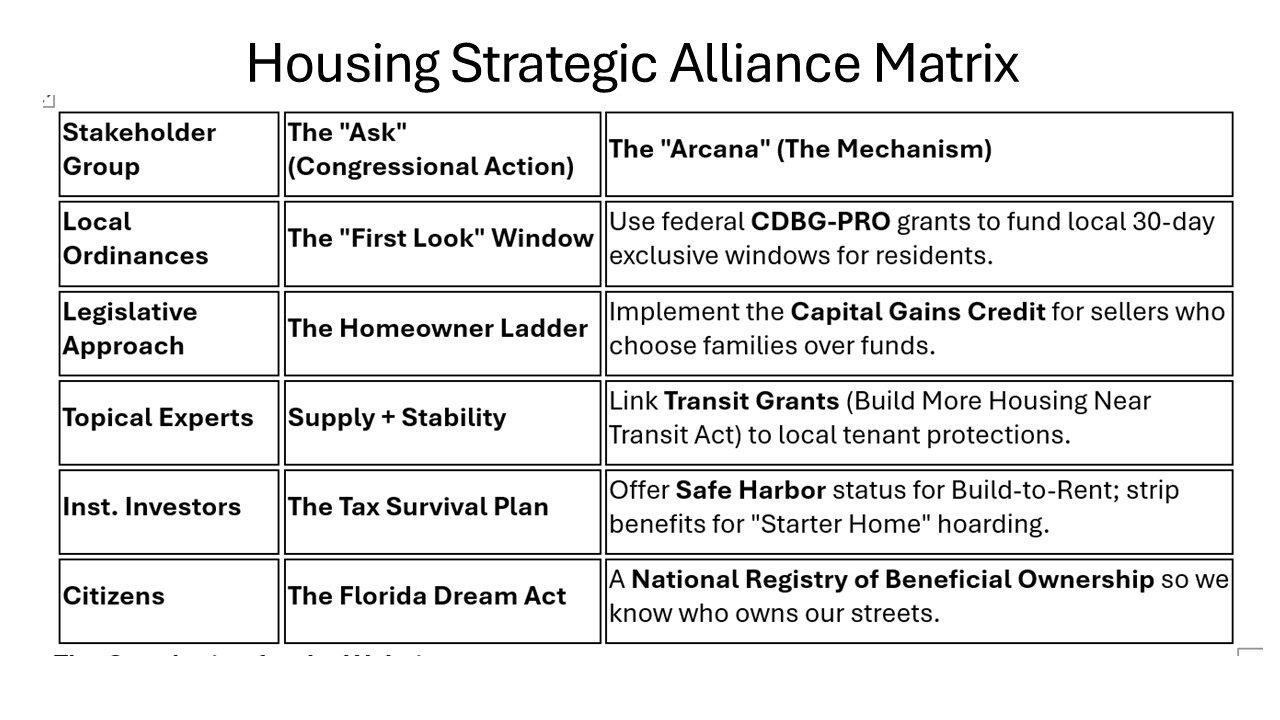
The JaxBNimble Takeaway: Don't Wait for D.C.
The fate of H.R. 10465 is a warning. Federal bills can be "putty" that never actually turns into "clay."
- The Opportunity Zone window (June–Sept 2026) is our best chance to force transparency at the state and local levels.
- We can't wait for a National Registry that might die in committee again.
- Joshua Hicks and the City Council have the power now to require transparency for any project receiving city land or "Live Local" tax breaks.
Click here and start typing. Magnam aliquam quaerat voluptatem ut enim ad minima veniam quis nostrum exercitationem ullam corporis.